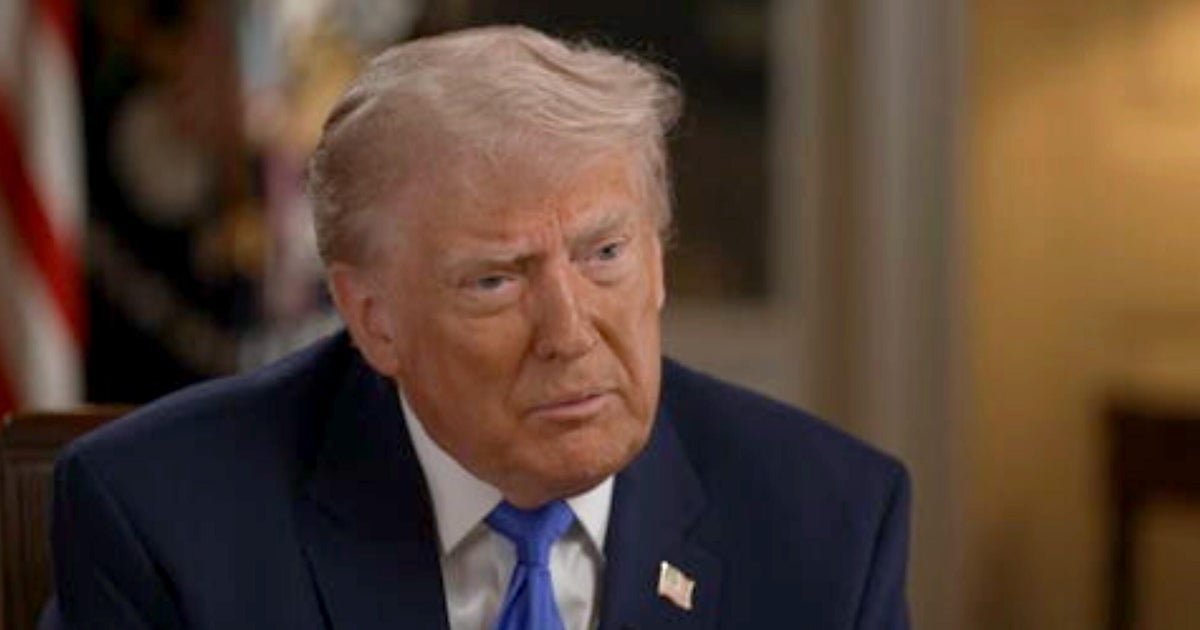
President Trump said he does not intend to expand the war with Iran, telling CBS News in an interview aired Sunday that he sees no cause to do so. His remarks came as Qatari Prime Minister Sheikh Mohammed bin Abdulrahman Al Thani was due at the White House on Monday, with Qatar acting as one of the main go-betweens in indirect U.S.–Iran talks. The same day, Iran's foreign ministry described a shortened timeline for a possible peace deal as a gesture of good faith, while Secretary of State Marco Rubio said the two sides were far from a breakthrough.
Why it matters
The comments point to a conflict that Washington and Tehran are both, at least publicly, trying to keep from widening, even as fighting and shipping attacks continue. Oil markets appear to be reading the signals that way: Brent crude, the international benchmark, dropped 2% early Monday to $96.38 a barrel, according to CBS News, extending a slide that has run for more than a week. Prices are still roughly 50% above where they stood a year ago, before the war, though well below the peak near $120 a barrel reached during the heaviest fighting.
Trump defends the decision to go to war
In the CBS interview, the president said he was "not looking" to intensify the campaign and did not think there was any reason to do so. He nonetheless strongly defended his choice to launch the conflict in late February, naming Iran's nuclear program as the central justification and saying he had done what was right for the country. He acknowledged the war has carried costs in the near term, saying it may not look like a good decision "for today and tomorrow," but predicted history would judge it favorably.
The White House is also pressing ahead with its maritime pressure campaign. In a Truth Social post on Sunday, Trump said the new U.S. military task force meant to broaden the Iran naval blockade "is in full force and effect." U.S. Central Command announced the unit, called Task Force Iron Gate, on Saturday, saying it would work to extend the blockade's reach to overland trade routes. Its stated job is to stop military technology and illicit revenue from crossing Iran's borders, including through the Caspian Sea, though it was not clear whether military force would be used.
Iran calls shorter deal window a sign of goodwill
Iran's foreign ministry spokesman, Esmaeil Baqaei, told Iranian journalists Monday that Tehran's offer to cut the implementation period for a possible peace agreement to two days, down from seven, was meant as a "sign of goodwill." He said any deal would have to keep the core terms both sides accepted under the earlier arrangement known as the Islamabad agreement, reached in June. According to CBS News, that pact covered lifting U.S. sanctions on Iran, ending the U.S. naval blockade of Iranian ports, releasing frozen Iranian assets and a ceasefire across the Middle East.
Baqaei added that if the other side were even minimally serious, Iran could carry out its obligations within two days, saying Tehran had already shown it was serious about meeting its commitments. The earlier ceasefire collapsed after several weeks when Iran called the continued U.S. naval blockade a breach of the terms.
Rubio, speaking to reporters before leaving for a G7 meeting in Paris late Sunday, played down the prospect of an imminent agreement. He said the two sides were not on the verge of a breakthrough and that talks had not been very productive because Iran's demands were "simply not just unacceptable." He repeated that the president favors a diplomatic resolution and said he expected G7 allies to raise many questions about the conflict and what comes next.
The administration has been seeking Iranian commitments on its nuclear program as part of an initial peace deal, while Tehran has long held that any discussion of the nuclear issue can only start once fighting and threats have stopped.
Shipping attacks continue in the Strait of Hormuz
The diplomatic maneuvering is unfolding against continuing violence at sea. Iran's state broadcaster IRIB said Monday that four tankers had been halted in the Strait of Hormuz over the previous 24 hours, posting on X that the ships were brought to a standstill without giving further details.
Both countries have struck vessels in and around the strait that they say violate their respective restrictions. Iran requires commercial ships to coordinate with its security forces to use lanes in the northern part of the strait, near its coast, and has fired missiles at vessels it accuses of taking southern routes that the U.S. says are safe and open. Iranian authorities have repeatedly claimed in recent weeks that ships on the southern routes struck sea mines and caught fire.
American forces, for their part, have attacked commercial vessels accused of breaking the U.S. blockade of Iran's ports and shipping, which is intended to cut off the government's oil and gas sales. On Saturday, U.S. Central Command said it disabled a commercial vessel in the Gulf of Oman, east of the strait, after its crew ignored repeated warnings and tried several times to run the blockade.
What to watch
The focus now is on Monday's White House meeting between Trump and the Qatari prime minister. Axios, citing sources, reported that Al Thani wants the president to give diplomacy more time. Whether Washington grants that room, and whether Tehran's shortened timeline moves the two sides any closer, will shape the next phase of a conflict that markets and the region are watching closely.